
Writing a Novel: A Look At My Process.
When I first started writing (12 years ago now) (how in the ever-living fuck has it been that long?) (people I went to school with have kids now? and I have books? What is happening?) (how do I stop using parentheses?) (help me) Sorry, what was I saying? Right. Writing. 12 years ago. Resist the urge to put another thought in brackets. Urge resisted. God, I’m good. But no, I’m actually done now. Back to being serious.
I was obsessed with other writers’ routines, habits, and even what laptop or notebook or pen they used — as if that might be the key to unlocking the genius they so expertly wielded. 12 years later, I can tell you it’s just a lot of hard work and not getting very far, but also somehow being light-years ahead of where you started. I remember trying to find the daily word counts of my heroes. How many pages did Terry Pratchett write every day? did he, in fact, write every day? and VE Schwab, was she an outliner or a make it up as you go along kind of writer? I paid an absurd amount of money for a James Patterson masterclass course (I was young and new to this world; don’t judge me, you bastards!) and actually learned a few things that have since served me well. Chief among them is a detailed outline. An outline so detailed it’s practically a first draft, but it’s not, because first drafts are daunting and outlines are not.
Thanks for reading! Subscribe for free to receive new posts and support my work.
So, I guess you could say I’m an outliner. But I go one step further, in that I outline the outline and then write a draft 0 and then a first draft. What the fuck am I talking about, and what do I mean? Well, dear reader, let's get nerdy and talk about my process in earnest, methodical steps. (Because this is exactly the kind of thing I used to look for and could never really find!)
Blake Polden’s Steps To Writing A Novel
Please note: wallowing, self-doubt, and thinking you’re shit are all part of the process, so just assume it’s present in every step; if you manage to forget it at any point, good for you! It’ll be standing behind you like a jump-scare horror villain at another point in this very long process. Yayyyy!
Have an idea
Think about it. noodle on it. Does it have what it takes? Don’t ask me how you know if it has what it takes; I’m not sure if I even know what I mean by that. It just felt right — and your idea will feel right too!Grab yourself some notecards
For the brainstorming phase, I use white ones. I’ll spend a good month or two just writing things on them. Characters. Bits of dialogue. Set-pieces. Scenes I think might be fun. Jokes. Tensions. Conflicts. Descriptions. Comp-titles. Anything that feels like it has some relevance goes on a notecard. This is my favourite part of the process. It feels like gathering treasure: suddenly every TV show or film you watch, suddenly every book or article you read has something you can take from. Like a magpie, you collect the shiny things. The way that film handles non-linear storytelling. The setting in that TV show. The comedy of that book. All of these things, when collected and stored away, will come in handy when it’s time to start building your world and your story.Organise the brainstorm
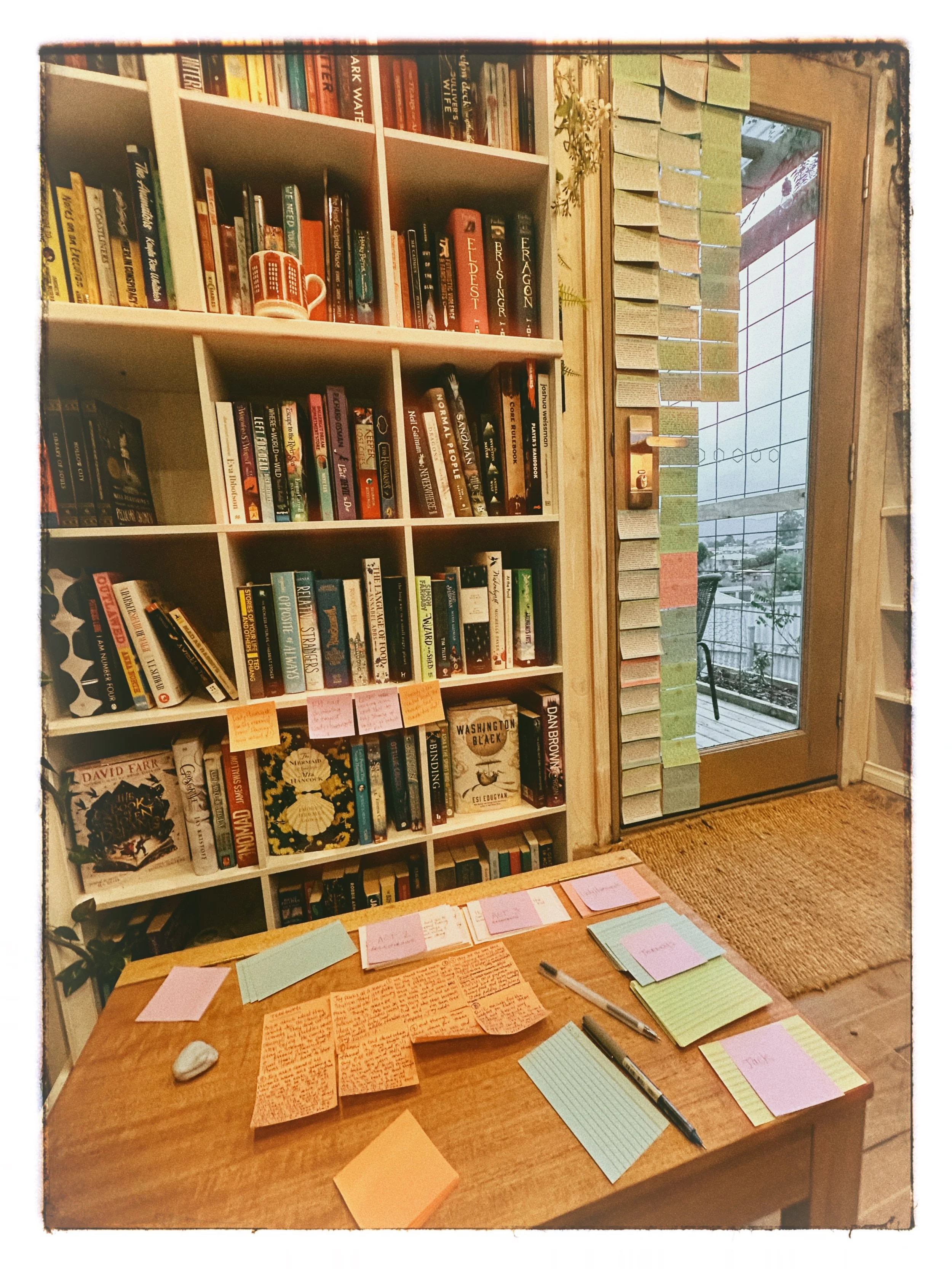
When it feels like you have enough cards, or that you’re too impatient and just want to get started, now you can start to divide and sort your cards into four distinct piles. ACT 1. ACT 2. ACT 3. And notes. Suddenly those fun scenes, that joke, that character, they have a place to live within your story. Have fun with this; pair unlikely scenes together. There’s a fun kind of friction when things that shouldn’t be together are forced to sit alongside one another. It creates comedy and tension. Now, you’re probably thinking, all of these random notes and scribbles don’t make a story. There’s no coherence here. Well, that’s where the next step comes into play.Turn the brainstorm into an outline
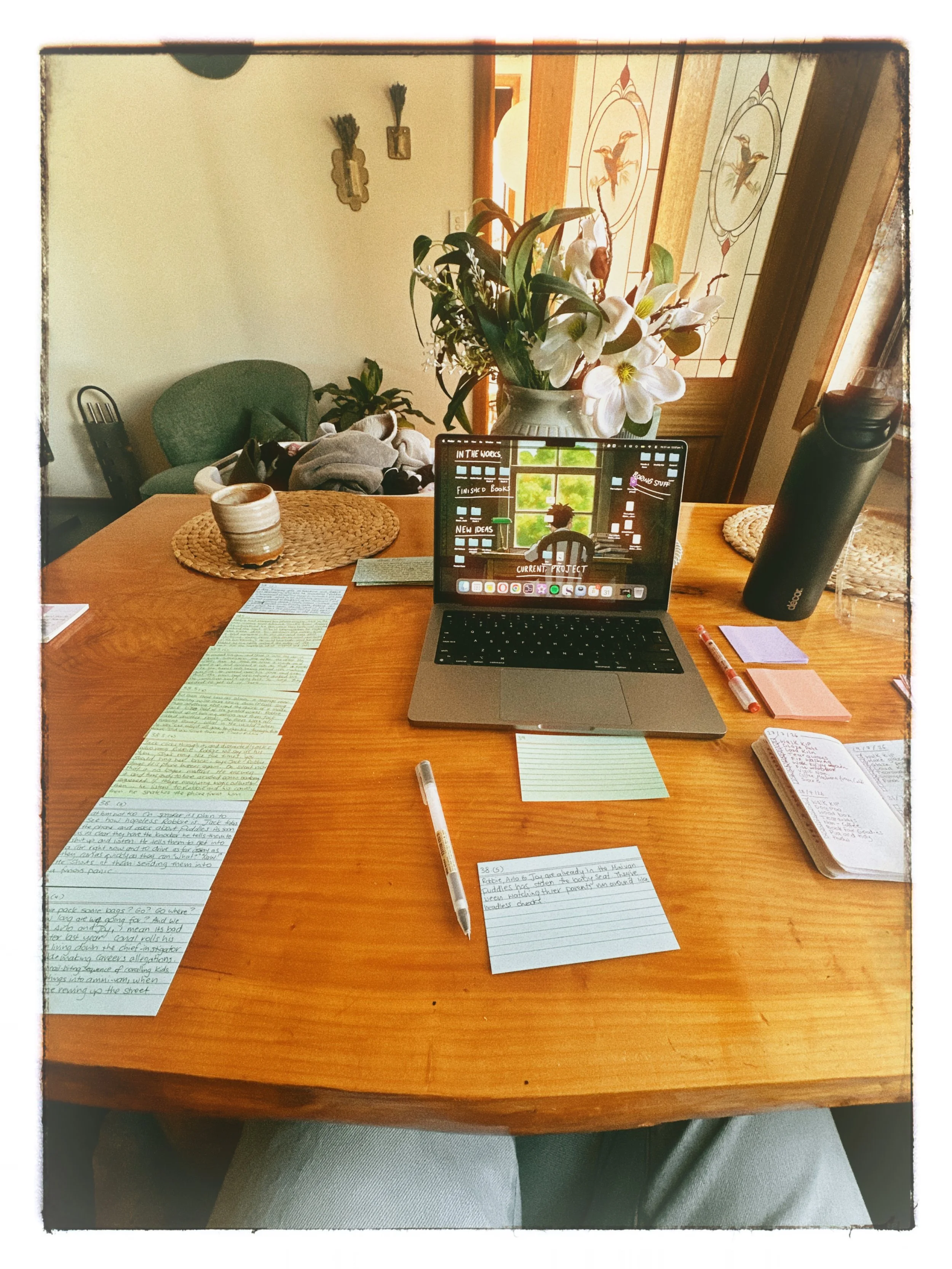
Here is where we’re going to fill in the blanks. If Character A needs to meet Character B, where the hell and when the hell does that happen? Put it on a notecard! This is where our story starts to take on a shape. Where we stick everything to a wall, or a window or a cupboard (or wherever you have enough space) to see the story grow and, more importantly, all at once. Because stories can feel like mammoth, overwhelming, gargantuan things. The more we can do here to make them feel smaller and more manageable, the better. I typically like to use a few different colours at this point. A colour for each character or POV. Or if you only have one main character, perhaps you need different colours to keep a hold of different points of time in the story. There are no hard and fast rules here, and whilst this works for me, you might find it convoluted and overwhelming. So only take the bits you think might be of service to you.Turn the outline into a draft zero
Draft zeros have been a game-changer for me. They stop me agonising over word choice and getting stuck on making the prose flow, and the words sound pretty whilst propelling the story forwards. Draft zeros, for me, allow me to write poorly and quickly without feeling like I’ve committed to anything. They let me tell myself the story, so that I can then make it into the story it needs to be.
I also write my draft zeros as a screenplay. I use Scrivener to write, and it has a screenplay function that I found on accident one day, and the rest was history. Suddenly, all of my very, very first drafts are written as dialogue and scene directions only. This does two things: it naturally makes the characters the driving force of the plot. Because it is their actions and their dialogue that moves the story forward. And it allows you to write without fussing over word choice or getting bogged down in the minutiae.Edit the draft 0
Have a break from the book. Ideally 1-2 months. Enough time so that when you come back you’ve forgotten what happens in such vivid detail. The goal here is to see it with fresh eyes. Perhaps that particular thing shouldn’t have happened until this particular thing happened. Or perhaps your character wouldn’t act like that, at least not before they did this. You get what I mean? And as a screenplay, it’s easier to pull apart and put back together, because you’re not breaking apart whole paragraphs of prose. It’s just essentially one big collection of scenes you can follow. Once Draft 0 more accurately represents the story you had in your mind, it’s time to start the first draft.Turn the draft 0 into a first draft
And now your first draft isn’t so bloody daunting! You already know what needs to happen. You already have a skeleton to build from. Now the prose is fun, and hopefully less daunting. Now you can turn a screenplay into a novel. How very Spielberg of you.First draft into a second draft
You finished a first draft! You did it!! Holy shit, you wrote a book! Now it’s time to celebrate. I celebrate by putting this first draft away and immediately beginning another story. Maybe you celebrate by buying yourself a nice book, going on a picnic, or watching a film at the cinema. However this looks for you, make sure you sit in that moment, and remind yourself you did what so many others have not. You wrote a whole damn book. And that’s something to be proud of.
I’m proud of you.
Print out your first draft and sit it on your desk and admire all those pages. All the hard work. The long nights, the early mornings, the stolen moments.
Now, second drafts aren’t fun. (at least not for me!) so make sure you sit in that glow of having completed a first draft for as long as possible. And the break from this book is just as important. Again, we need to have enough time away from it so that when we come back it’s like we’re not reading our own work. We need to be as subjective and ruthless as we possibly can be. What’s not working? That dialogue, it’s so unrealistic — no one talks like that.
Take to your printed first draft with a red pen and underline and cross out and write in the margins. Here is where we make the book better. (Notice I said better and not perfect? Repeat after me: Perfection is an unachievable gold pot at the end of a rainbow; it will always be just out of sight no matter how long you chase it!)Then continue to make it as good as you possibly can make it, then get someone else’s eyes on it!
Now you’ve edited the first draft; it’s time to type those changes into your doc. Make the book as good as you possibly can and then get someone else’s eyes on it. Ask them to be brutal and honest, but ideally, to also be as kind as possible and cheer you on about the bits that they did like. The book that exists in your head might not be on the pages yet, but you’ve hopefully got an entire lifetime to close that gap. It’s not for everyone, but if it’s for you, you will make it happen. You’ve got to believe in yourself when no one else will. Plus, dear reader, you’ve already got me. I believe in you. So get out there and write your fucking story. The world needs your work, your messy, heartfelt, funny and most human of human works — now more than ever.
I hope this helps. I’m currently on step 4; my note card outline is growing steadily! The Strangest Criminals 2 is almost at the draft 0 stage.
I’m excited to see what you write. What makes you, as a person, laugh and cry? What gives you goosebumps of joy? All things of which are vitally important to the process of writing. So pick up a pen, open that Word doc and get to work.
And repeat after me: FUCK. GENERATIVE. AI.
